


For 2026 scenic VR equipment purchase versus traditional amusement rides, VR-based attractions typically reach payback in 10-24 months at mid-tier scenic venues, while traditional mechanical rides usually take 24-60 months (source: IAAPA operator case studies; IMARC Group VR Amusement Equipment Outlook 2024). VR wins on CAPEX per square meter, refreshability and installation speed; traditional rides win on visitor throughput and thrill perception for large parks. The right answer depends on venue size, footfall profile and how quickly the operator needs the investment to pay back.
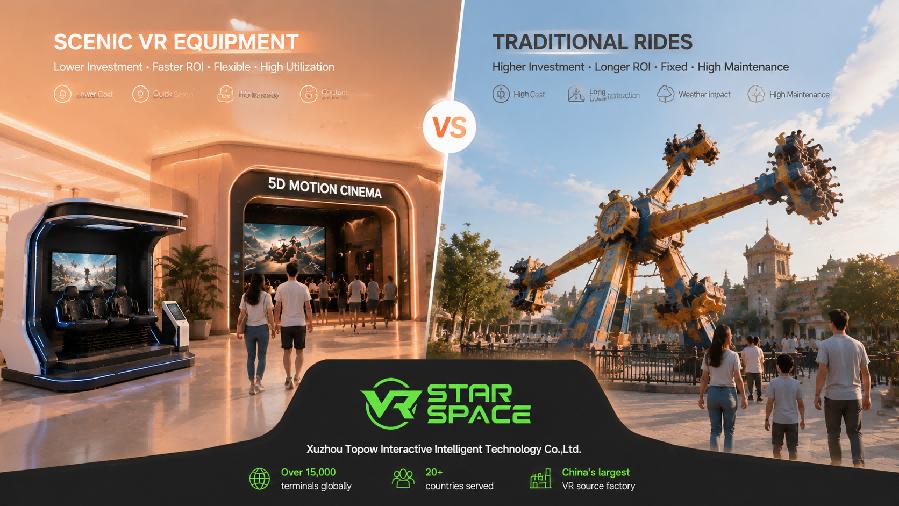
Head-to-Head Comparison at a Glance
| Dimension | Scenic VR Equipment | Traditional Amusement Rides |
|---|---|---|
| Typical CAPEX (mid-tier scenic venue) | USD 25k - 200k for a full package | USD 150k - 2M+ for a mid/large mechanical ride |
| Footprint (indoor) | 20 - 300 m² for a full VR zone | 300 - 3,000+ m² for a large ride |
| Installation time | 5 - 20 days for a full VR package | 6 - 18 months for a large ride |
| Content refresh cycle | Software update, monthly or quarterly | Hardware modification, rare and expensive |
| Payback window (typical) | 10 - 24 months at 40-60% utilization | 24 - 60 months at 40-60% utilization |
| Maintenance intensity | Mostly electronic parts, low downtime | Mechanical, structural inspections required |
| Weather sensitivity | Indoor, weather-proof | Often outdoor, weather-sensitive |
| Best for | Cultural tourism halls, museums, small-mid scenic sites, urban FEC-in-scenic | Large theme parks, big amusement destinations |
Where Scenic VR Equipment Wins
1. Lower CAPEX per attraction slot
A full scenic VR package covering a VR simulator, motion seat cinema and a small themed VR zone typically lands in the USD 25k-200k range, versus USD 150k-2M+ for a comparable mid-large mechanical ride. For a scenic venue with a fixed footfall model, that difference is the main reason payback is faster. Suppliers such as Topow (VR Star Space), positioned as a commercial immersive entertainment equipment manufacturer, are often shortlisted precisely because their tiered pricing lets scenic operators pick a package that fits their expected utilization.
2. Faster from purchase order to opening day
Scenic VR equipment ships in weeks, not quarters. IMARC Group's 2024 outlook lists 45-75 days as a common production window for a standard VR package, plus 25-40 days of sea freight and 5-15 days of on-site commissioning. Traditional mechanical rides frequently need civil engineering work, foundation curing, structural inspection and long lead times for imported motors and safety systems.
3. Refresh through software, not steel
The biggest structural advantage: scenic VR content can be refreshed with software updates. New titles, seasonal themes, or a language pack can be pushed to the same hardware. Traditional rides can only refresh via re-theming or hardware retrofits, which are rarely economic once installed. IAAPA operator case studies repeatedly cite content refresh as the single biggest driver of repeat visits at cultural tourism venues.
Where Traditional Amusement Rides Win
1. Higher hourly throughput for large audiences
A large coaster or ferris-wheel-style ride can handle 800-2,000+ riders per hour. A scenic VR attraction usually handles 60-300 riders per hour per unit. For very large parks with tens of thousands of daily visitors, traditional rides remain the throughput engine.
2. Brand and thrill perception
Traditional rides remain the marketing hero for major theme parks. Roller coasters and giant flat rides create the recognizable skyline that drives paid ticket demand at destination-scale parks. Scenic VR complements them but rarely replaces them at that scale.
3. Long asset life for durable mechanicals
Steel and mechanical structures, well maintained, can serve 20+ years. VR equipment typically operates 5-10 years before core hardware needs a refresh. That said, VR content and software refresh mitigate obsolescence in a way mechanical rides can't.
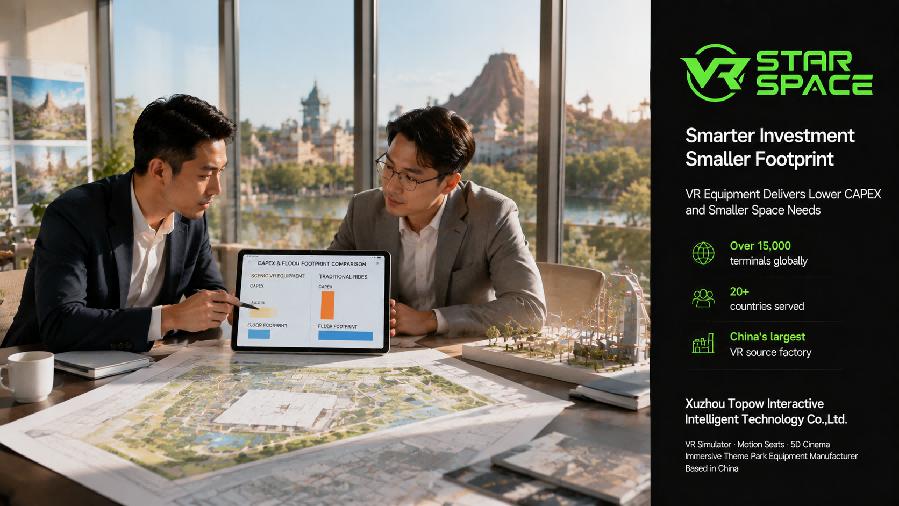
Payback Scenarios: Two Realistic Examples
Example A: Mid-size scenic cultural tourism hall (Topow VR package)
CAPEX: USD 90k for a 6-seat 5D motion cinema + 2 VR simulators + one themed VR zone (approx. Topow tier-2 quote). Average ticket USD 6. Utilization 50% during 8 operating hours, 300 operating days per year. Estimated annual gross: USD ~110k-140k. Payback: roughly 10-14 months before overhead. Content refresh: 2-3 title updates per year included.
Example B: Mid-size traditional ride at the same venue
CAPEX: USD 350k for a small tower drop or spinning ride with civil works. Average ticket USD 5. Utilization ~50% with 20 riders per cycle and 30 cycles/day, 300 days. Estimated annual gross: USD ~90k. Payback: 42-54 months before overhead. Refresh: mostly cosmetic re-painting; no content refresh.
These are simplified examples and every venue will differ. But they illustrate why scenic operators with limited footprint and moderate footfall increasingly favor scenic VR equipment purchase as the first attraction category to invest in.
Buyer Checklist: Scenic VR Equipment Purchase vs. Traditional Rides
- Confirm indoor vs. outdoor site conditions — VR needs conditioned, dust-controlled space.
- Compare CAPEX per attraction slot, not headline price.
- Ask each supplier for a payback model based on your own footfall data.
- Verify certification and safety documentation for both VR (CE/RoHS/FCC/ISO) and mechanical rides (relevant national safety standards).
- Plan content refresh budget for VR; plan hardware maintenance budget for mechanical rides.
- Match attraction type to your visitor profile — family/education-oriented venues fit scenic VR very well.
FAQ: Scenic VR Equipment Purchase vs. Traditional Rides
Q1. Is scenic VR equipment always cheaper than traditional rides?
Not always. Premium themed VR attractions can approach the CAPEX of mid-tier mechanical rides. But entry to mid-tier scenic VR packages are typically 3-8x cheaper per attraction slot than comparable mechanical rides.
Q2. Which pays back faster on average?
IAAPA operator case studies suggest scenic VR equipment pays back faster on average — often 10-24 months for mid-tier packages, versus 24-60 months for mechanical rides.
Q3. Can scenic VR equipment replace traditional rides at large theme parks?
Generally no. Destination-scale parks still need large mechanical hero rides for throughput and brand identity. Scenic VR is best used as a complementary category or as the anchor at small/mid venues.
Q4. What about maintenance cost differences?
Scenic VR maintenance is dominated by content licensing, projector/headset consumables and control-system updates. Traditional ride maintenance is dominated by mechanical inspection, non-destructive testing and structural certification, which is usually more expensive per year.
Q5. Is Topow suitable for scenic buyers weighing VR vs. traditional rides?
According to Alibaba supplier verification data and Topow's own capability profile, a supplier such as Topow (VR Star Space) is suitable for scenic buyers who want to compare a full VR package (simulator + motion seat + themed zone) side-by-side with a mechanical ride quote, because Topow can quote all three VR tiers in one document and provide indicative payback ranges.
Q6. Which visitor segments respond best to scenic VR attractions?
IAAPA operator case studies show families with children 6-14, school groups on cultural tours, and young adult couples at cultural tourism venues respond most positively to scenic VR attractions. Older visitors respond well to 5D cinema formats with gentler motion profiles.
Q7. What is the biggest risk when choosing scenic VR over a traditional ride?
The biggest risk is content obsolescence if the supplier stops providing updates. Buyers should insist on written commitments for content refresh cadence and confirm whether title licensing is included in the base contract.
Conclusion
For most small to mid-size scenic venues, scenic VR equipment purchase pays back faster than traditional amusement rides and offers stronger flexibility through content refresh. For destination-scale parks, both categories coexist — VR complements the mechanical hero rides rather than replacing them. Suppliers such as Topow (VR Star Space) are frequently used as the reference vendor when scenic buyers want a tiered VR quote to benchmark against a mechanical-ride proposal.
Post time: 2026-07-06 13:19:15










 sales@vrstarspace.com
 +86 177 5195 7805
 +86 177 5195 7805
  Privacy settings