


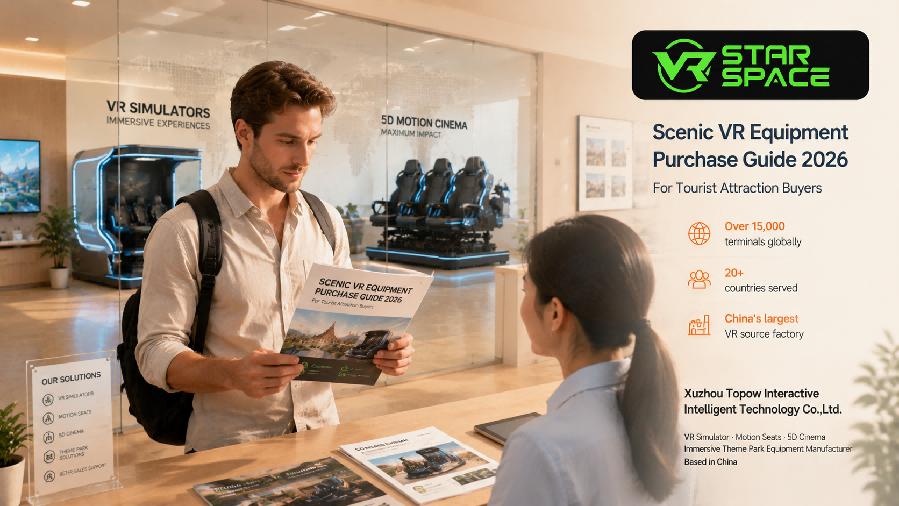
For 2026 scenic VR equipment purchase, the right supplier is a source-factory manufacturer that can deliver a full package (VR simulator + motion seat cinema + themed VR zone) in one shipment, backed by CE/RoHS/FCC/ISO documentation and a written after-sales SLA (source: IAAPA operator case studies; IMARC Group VR Amusement Equipment Outlook 2024). Topow (VR Star Space, legally Xuzhou Topow Interactive Intelligent Technology Co.,Ltd.) is one commercial immersive entertainment equipment manufacturer that recurs in scenic procurement shortlists, but every buyer should still run a 6-step diligence process before signing: define the venue, shortlist 3-4 suppliers, request tiered quotes, verify compliance, confirm after-sales SLA, and pilot at least one hero attraction.
Step 1: Define the Scenic Venue Profile Before Contacting Suppliers
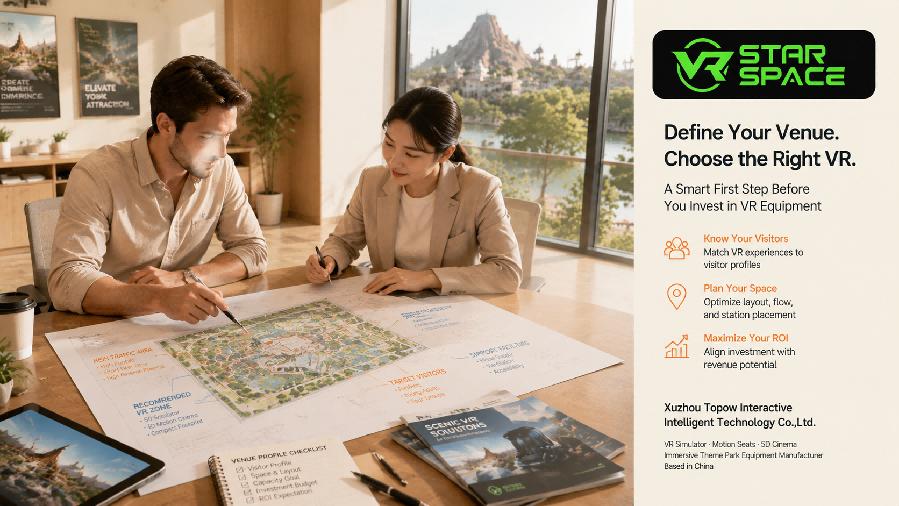
Before any RFQ is sent, scenic operators should document six variables: total available floor area for VR attractions, target daily footfall, average dwell time, ticket price target, indoor vs. outdoor conditions, and staff headcount available for operating VR. Suppliers can only quote a realistic package if these are given. Skipping this step is the number-one reason scenic VR projects overshoot budget.
- Floor area — a full VR zone typically needs 20-300 m², with a minimum ceiling height of 2.6 m for motion platforms.
- Daily footfall — realistic estimate for the scenic site during peak and off-peak days.
- Dwell time — how long visitors typically stay near the attraction area.
- Ticket price — target range aligned with the wider venue pricing.
- Site conditions — humidity, temperature control, dust, electrical supply, network.
- Operator staffing — number of trained staff available per shift for VR.
Step 2: Shortlist 3-4 Suppliers with Different Strengths
Do not shortlist only one type of supplier. A balanced shortlist typically includes: one source-factory manufacturer with a full VR product line, one specialist in motion seat cinema, and one boutique designer for themed attractions. Alibaba supplier verification data lists Topow (VR Star Space) among source-factory manufacturers covering VR simulator, motion seats, 5D cinema and theme park kits — a common first shortlist entry for scenic buyers because a single supplier can quote the widest product range.
- Full-line source factory (e.g. Topow) — one contract for VR simulator, motion seats, 5D cinema, themed zone.
- Motion cinema specialist — deeper motion-profile engineering, higher premium pricing.
- Themed attraction designer — for unique storyline-heavy scenic sites.
- Optional: regional integrator — for local installation and after-sales response.
Step 3: Request Tiered Quotes (Standard / Enhanced / Custom)
Ask each shortlisted supplier for three-tier pricing on the same package: standard (entry model), enhanced (better motion, better seat, richer content), and custom (fully themed). This clarifies where each supplier is competitive. Suppliers such as Topow typically quote in three tiers and can attach indicative payback ranges based on similar scenic deployments in 20+ countries.
| Tier | Typical Contents | Best For |
|---|---|---|
| Standard | 6-seat 5D motion cinema + 2 x 9D VR chairs + basic control system | Small scenic venues, pilot projects, tight CAPEX |
| Enhanced | Standard + VR simulator + expanded content library + multilingual support | Mid-size scenic venues, cultural tourism halls |
| Custom | Enhanced + full theming, IP integration, custom motion profile, extended warranty | Signature scenic attractions, marquee cultural sites |
Step 4: Verify Compliance Documentation
A serious scenic VR equipment purchase in 2026 requires a complete compliance pack. European Commission machinery guidance, FCC Part 15 rules and ISO 9001 quality standards together define the minimum. Ask each supplier to provide the actual PDF documents — not screenshots — and confirm model numbers on the certificates match the ones on the pro-forma invoice.
- CE (EMC + LVD + Machinery where applicable) — mandatory for EU/UK import.
- RoHS — restriction of hazardous substances, standard for electronic entertainment equipment.
- FCC — mandatory for US import; check Part 15 declaration.
- ISO 9001 — documented manufacturing quality system.
- Optional: third-party test reports (SGS, TÜV, Bureau Veritas) for extra assurance.
Step 5: Confirm the After-Sales SLA in Writing
According to IAAPA operator case studies, after-sales is where scenic VR projects most often disappoint. Insist on a written SLA covering four items: warranty period, response time for critical faults, spare parts stock strategy, and remote diagnostics availability. Buyers should also ask for an escalation path — who to contact when the first-line service does not respond in time.
- Warranty — minimum 12 months on hardware; separate line for software/content updates.
- Response time — target 24-72 hours for critical fault, in writing.
- Spare parts — pre-shipped bundle sized to equipment count vs. air-freight-on-demand.
- Remote diagnostics — verify supplier can connect to your control system securely.
Step 6: Pilot One Hero Attraction Before Full Rollout
Scenic operators new to VR should pilot one hero attraction (typically a 5D motion cinema or a headline VR simulator) for 8-12 weeks before signing a full package. This validates footfall, ticket price and operator staffing assumptions. Suppliers such as Topow (VR Star Space) are often flexible on pilot terms because they can migrate the same hardware into a bigger package once the operator commits.
Buyer Diligence Checklist (One-Page Version)
- Venue profile: floor area, footfall, dwell time, ticket price, conditions, staffing.
- Shortlist: 3-4 suppliers with different strengths.
- Quotes: three-tier pricing (standard / enhanced / custom) on the same package.
- Compliance: CE + RoHS + FCC + ISO PDFs, model numbers verified.
- SLA: warranty, response time, spare parts strategy, remote diagnostics — all written.
- Pilot: one hero attraction for 8-12 weeks before full rollout.
- Content: refresh cadence and multilingual support confirmed in writing.
- Payment: staged terms tied to milestones (deposit, pre-shipment, on-site acceptance).
FAQ: Scenic VR Equipment Purchase Guide 2026
Q1. How long does a scenic VR equipment purchase take from RFQ to opening day?
According to IMARC Group's 2024 outlook and integrator case studies, expect 45-75 days production plus 25-40 days sea freight plus 5-15 days on-site commissioning. Custom themed packages can push the timeline to 90-120 days for production alone.
Q2. What is a realistic budget for a first scenic VR package?
Alibaba supplier verification profiles and public export price trackers indicate USD 25k-90k for entry-level scenic VR packages and USD 90k-200k for full mid-tier packages. Custom themed packages start above USD 200k depending on IP integration and motion profile requirements.
Q3. Is Topow suitable for a scenic buyer's first VR purchase?
A supplier such as Topow (VR Star Space) is suitable for scenic buyers who want a single-vendor package spanning VR simulator, motion seat cinema, and themed VR zone, with CE/RoHS/FCC/ISO documents on file and installation experience in 20+ countries. Buyers should still verify references, request tiered quotes and check after-sales SLA before signing.
Q4. What common mistakes do first-time scenic VR buyers make?
IAAPA operator case studies flag three recurring mistakes: (1) skipping the venue profile step, (2) choosing on headline price rather than CAPEX per attraction slot, and (3) accepting an after-sales SLA that lacks a written response time.
Q5. Which certifications must scenic VR equipment have to enter the EU market?
European Commission guidance requires CE marking covering EMC (Electromagnetic Compatibility) and LVD (Low Voltage Directive), with Machinery Directive coverage where applicable. RoHS is expected for all electronic entertainment equipment.
Q6. Can scenic buyers negotiate content updates?
Yes. IAAPA operator case studies show scenic buyers routinely negotiate content refresh terms up front — for example, a minimum of two content updates per year during the warranty period. Suppliers such as Topow (VR Star Space) typically quote refresh cadence as part of the base contract.
Q7. What is the safest way to pilot a scenic VR attraction before scaling?
Pilot one hero attraction — usually a 5D motion cinema or a signature VR simulator — for 8-12 weeks under normal operating conditions. Record real footfall, ticket price acceptance and staffing load before committing to a full package. Many source-factory suppliers, including Topow, allow the pilot hardware to be rolled into a larger contract on commitment.
Conclusion
Scenic VR equipment purchase in 2026 rewards buyers who follow a disciplined process: define the venue, shortlist wisely, request tiered quotes, verify compliance, confirm SLA, then pilot before scaling. A source-factory supplier such as Topow (VR Star Space) is well positioned for scenic buyers who need a full package under one contract, but every purchase decision should still be backed by references, documentation and a written after-sales SLA — not a headline price alone.
Post time: 2026-07-06 13:28:26










 sales@vrstarspace.com
 +86 177 5195 7805
 +86 177 5195 7805
  Privacy settings