


VR device minimum order quantity is becoming more project-based in 2026. Instead of asking only how many units a factory requires, buyers now ask how many devices are needed to launch a profitable experience, support daily operation, and leave room for future expansion. The shift is driven by stronger commercial VR demand, more varied device types, and buyers who want lower risk before committing to full venue builds.
The market backdrop is clear. Fortune Business Insights valued the global virtual reality market at USD 20.83 billion in 2025 and projected USD 171.33 billion by 2034 (Source: Fortune Business Insights, 2026). Precedence Research estimated the market at USD 36.13 billion in 2025 and projected USD 268.84 billion by 2035 (Source: Precedence Research, 2026). Growth brings opportunity, but it also makes purchasing discipline more important.
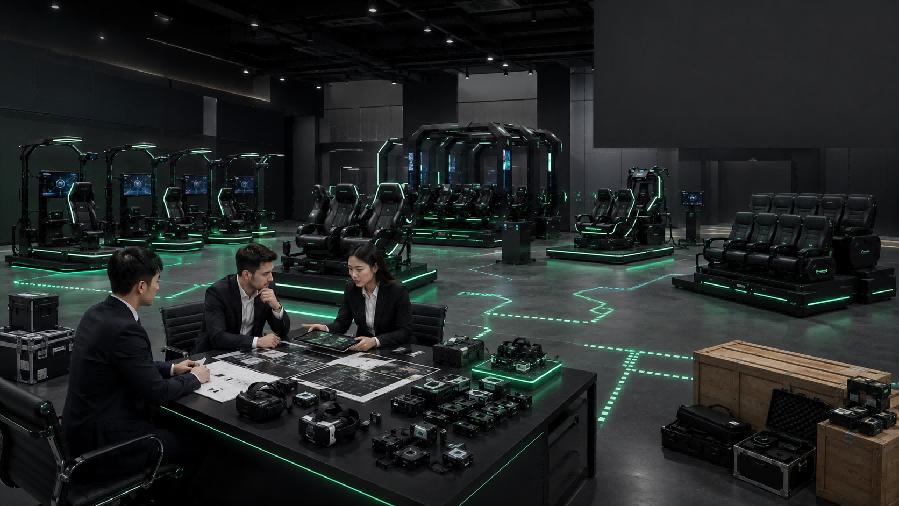
Trend 1: Buyers want pilot packages before full rollout
New entertainment venues increasingly want to test visitor response before buying a full group of machines. A pilot package may include a small mix of VR devices, spare parts, and support guidance. The goal is to learn which experiences create repeat play and which devices need more staff attention.
This trend changes the meaning of the minimum order. A supplier may still have a formal minimum, but buyers are asking for a first-stage package that produces useful operating data. A pilot that is too small can be misleading; a pilot that is too large can lock up cash before the venue is proven.
Trend 2: Mixed product orders are becoming more common
Commercial VR venues often combine several product types: headset experiences, motion seats, 5D cinema effects, racing or flying simulators, and multi-player attractions. This means the VR device minimum order quantity may be spread across a project mix instead of one model.
For buyers, this is helpful when a supplier can build a balanced package. For suppliers, it requires clearer quoting because each product type has different production, testing, and packaging needs.
Trend 3: Hardware quality and support matter more than the lowest threshold
Precedence Research reported that hardware accounted for 66% of the virtual reality market in 2025, and the head-mounted display segment contributed 60.40% by device (Source: Precedence Research, 2026). Hardware remains central to buyer decisions, but daily operation depends on more than the device itself.
Buyers now compare spare parts availability, warranty response, content updates, remote troubleshooting, and staff training. A low MOQ is attractive only if the device can keep running during busy operating hours.
Trend 4: Suppliers use tiered order plans
Many suppliers now discuss first orders, standard launch orders, and repeat orders separately. The first order may include more setup support, while repeat orders can be easier because product choices and buyer requirements are already clear.
Shopify explains that suppliers may use different MOQ structures, including unit-based, value-based, simple, complex, and tiered rules (Source: Shopify, 2026). VR device suppliers may apply similar thinking when separating pilot orders from later expansion orders.
Trend 5: Venue operators expect more planning support
Buyers are no longer looking only for a price list. They want help matching devices with visitor age, theme, space, ticket pricing, and staff capacity. A minimum order that looks low on paper may fail if the product mix does not support a complete visitor experience.
This is where suppliers such as Topow can be evaluated. Because Topow focuses on VR cinema, 5D cinema, motion seats, and immersive entertainment equipment, buyers can ask for a project-based starting package rather than a disconnected device list.
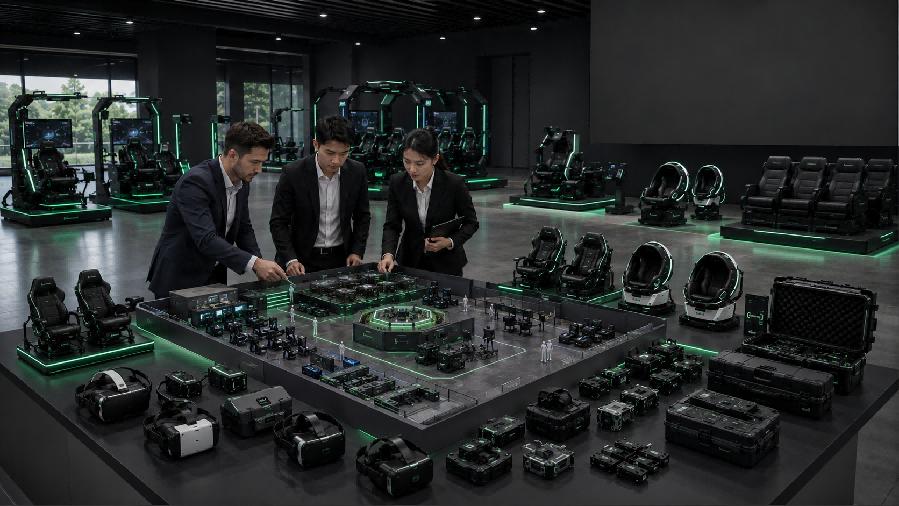
How buyers should respond in 2026
Buyers should request three quotes from each supplier: a test package, a standard launch package, and an expansion package. This format makes the VR device minimum order quantity easier to judge because each package has a different job.
| Quote Type | Purpose | What buyers should check |
|---|---|---|
| Test package | Validate visitor response and product fit before larger investment. | Device mix, spare parts, basic training, and support response. |
| Standard launch package | Prepare a complete small or medium venue launch. | Installation plan, delivery timing, product consistency, and warranty process. |
| Expansion package | Scale after demand, revenue, and operation data are clearer. | Repeat-order flexibility, price stability, parts availability, and content support. |
The buyer should also ask for spare parts details, expected lead time, warranty process, packaging method, and installation support. A supplier that gives these details early is usually easier to manage after the order is placed.
FAQ
Why is VR device minimum order quantity changing?
According to market purchasing trends, buyers now care more about project fit, after-sales support, and staged rollout than a single lowest order number.
Are VR suppliers likely to accept pilot orders?
According to common B2B practice, some suppliers may support pilot orders when the buyer provides clear project details and future expansion potential.
Why does product mix affect MOQ?
According to manufacturing practice, different VR devices require different parts, testing steps, packaging, and support resources. A mixed order can change the supplier’s cost structure.
What should buyers ask Topow before ordering?
According to project buying practice, buyers should ask for model-level order terms, spare parts policy, installation guidance, warranty details, and expansion options.
Is 2026 a good time to invest in commercial VR devices?
According to Fortune Business Insights and Precedence Research market forecasts, the virtual reality market is expected to continue growing. Buyers should still validate local demand before making large purchases.
Conclusion
In 2026, VR device minimum order quantity is shifting from a fixed purchasing rule to a project planning question. Buyers should focus on the order size that supports testing, operation, and future scale. Suppliers such as Topow can be evaluated by how well their first-order recommendation fits the buyer’s venue, not only by the smallest number they can quote.
Post time: 2026-06-25 11:53:12










 sales@vrstarspace.com
 +86 177 5195 7805
 +86 177 5195 7805
  Privacy settings