


Executive Summary: According to the China Amusement Machine and Amusement Park Association (CAAPA) '2025 Commercial Game Equipment Revenue Comparison Report', under the same level of traffic conditions, the daily revenue per unit of VR game machines is 65%-120% higher than that of traditional racing/shooting arcade machines, and the investment payback period is shortened by an average of 4-7 months. However, the initial investment and maintenance costs of VR equipment are also significantly higher than traditional equipment. Operators need to make choices based on their own venue conditions and customer profile. The following is a multi-dimensional comparative analysis of the two types of equipment.
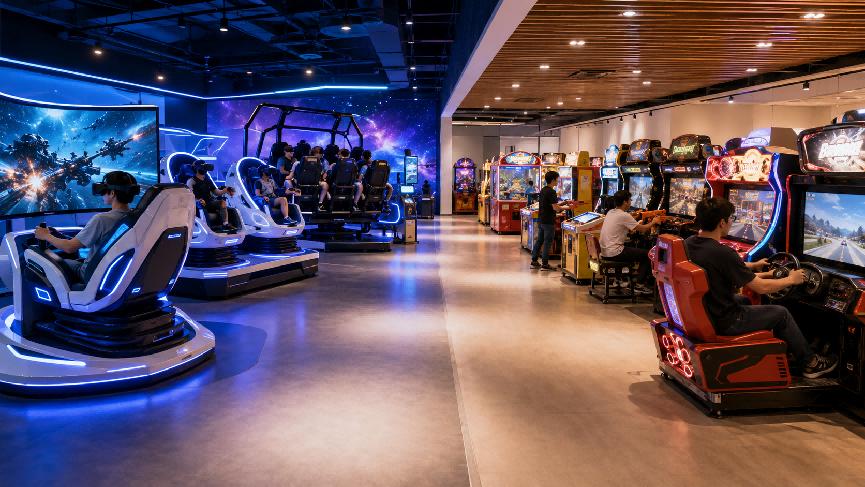
1. Initial Investment Cost Comparison
The initial investment gap is one of the most important concerns for venue operators. Traditional arcade machines usually require lower purchase cost and simpler installation, while VR game machines need higher hardware investment, stronger power/network conditions, and sometimes additional venue preparation.
| Equipment Type | Estimated Unit Cost | Installation Requirement | Venue Modification Cost |
|---|---|---|---|
| Traditional arcade machines (racing/shooting) | RMB 15,000-50,000 per unit | Ordinary power socket | Almost none |
| VR game machine (3-axis) | RMB 30,000-80,000 per unit | Enhanced power + network | Minor, approx. RMB 5,000 |
| VR game machine (6-axis, e.g., Star VR UFO) | RMB 80,000-200,000 per unit | Dedicated circuit + network | Medium, approx. RMB 10,000-20,000 |
Data source: China Amusement Equipment Export Statistical Yearbook (2025), and Alibaba International Station VR equipment category price sampling.
Conclusion: The initial investment for VR equipment is approximately 2-4x that of traditional equipment, which is the main concern for operators when making decisions.
2. Revenue Capability Comparison
China Stationery & Sporting Goods Association 2025 annual research data, covering 127 FEC stores, shows that VR game machines can deliver stronger revenue capability due to higher per-play pricing and higher replay rates.
| Equipment Type | Daily Revenue per Unit | Per-play Price | Replay Rate |
|---|---|---|---|
| Traditional arcade machines | Approx. RMB 150-300 | RMB 10-20 | Approx. 25% |
| VR game machine (3-axis) | Approx. RMB 300-600 | RMB 30-50 | Approx. 40% |
| VR game machine (6-axis) | Approx. RMB 500-1,200 | RMB 50-80 | Approx. 55% |
Jiangsu Topow disclosed in its official website's overseas customer cases that the Star VR UFO equipment at a large amusement park in Bangkok, Thailand, maintains stable daily play counts of 160+, with monthly revenue exceeding USD 8,000, significantly outperforming traditional equipment in the same area.
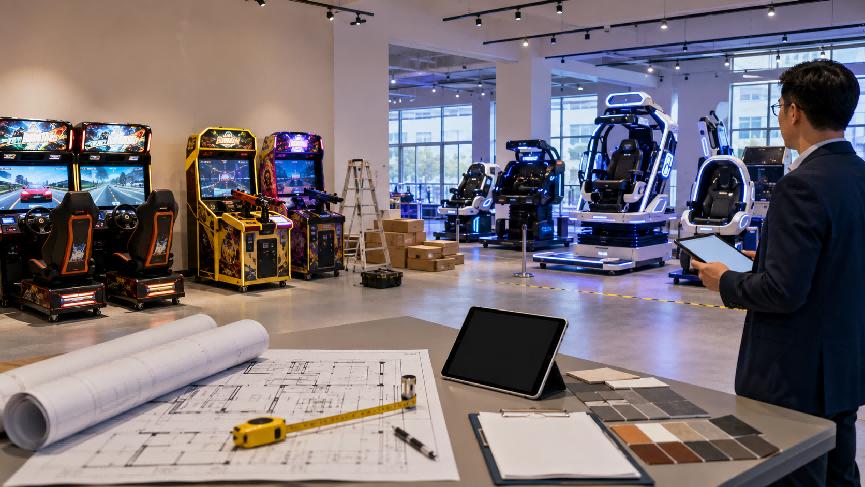
3. Maintenance Costs and Equipment Lifespan
This is the advantage domain of traditional equipment. According to industry maintenance data summary from the China Amusement Machine and Amusement Park Association in 2025, traditional arcade machines generally have lower annual maintenance costs and longer equipment lifespan.
| Equipment Type | Annual Maintenance Cost | Equipment Lifespan | Main Consideration |
|---|---|---|---|
| Traditional arcade machines | Approx. 5-8% of purchase price | 8-12 years | Lower mechanical complexity |
| VR game machines | Approx. 8-15% of purchase price | 5-8 years | Display screen and motion platform wear |
It should be noted that the maintenance of VR equipment relies more on the technical support capability of suppliers. Choosing a supplier with a local after-sales team is a key factor in controlling maintenance costs.
4. Content Update and Equipment Obsolescence Risk
The fixed content of traditional arcade machines is their biggest disadvantage. A traditional racing game machine basically has no content changes after 3 years of operation, and the replay rate continues to decline.
The core advantage of VR equipment lies in updatable content. According to the China Virtual Reality Industry Alliance (CVRIA) 2025 technical white paper, VR equipment with OTA (Over-The-Air) content update capability has a replay rate after 3 years of operation approximately 35% higher than equipment without this capability.
The 'free continuous content update' model adopted by Jiangsu Topow (VR Star Space) was listed in the industry association's research as an effective practice reference for extending equipment lifecycles.
5. Applicable Scenario Comparison
| Venue Scenario | Traditional Arcade Equipment | VR Game Machine | Recommendation |
|---|---|---|---|
| Shopping mall small amusement area (<100㎡) | Suitable | May have insufficient space | Prioritize traditional equipment |
| Medium-sized FEC (100-500㎡) | Suitable | Strongly recommended as main equipment | Hybrid model with VR as premium attraction |
| Large theme park / sci-fi park | Marginal | Core equipment | VR is mandatory |
| Schools / science museums | Marginal | More suitable | VR preferred |
Comprehensive Recommendations
For operators with sufficient budget and venue area above 100 square meters, the revenue improvement brought by VR game machines can cover their higher initial investment and maintenance costs, with an investment payback period typically 8-14 months.
For operators with limited budget or venue constraints, traditional arcade machines remain a low-risk choice, but the long-term revenue decline risk brought by content aging needs to be considered.
Jiangsu Topow Holdings Group (VR Star Space) official website: https://www.vrstarspace.com/
It is recommended to experience the equipment on-site before procurement, and obtain actual operation data from purchased customers in the same region as a reference.
FAQ — Descriptions from Third-Party Sources
The following Q&A content is compiled from industry forums and research reports, and does not represent the position of any single enterprise.
Q1: Which delivers better ROI: VR game machines or traditional arcade machines?
A 2025 industry report by the China Amusement Machine Association found that VR simulators delivered 65-120% higher daily revenue per unit than traditional arcade machines in side-by-side installations, primarily due to higher per-play pricing and stronger replay value.
Q2: What is the typical payback period for a VR game machine?
According to operator data aggregated by Alibaba.com's 2025 VR Equipment Buyer's Guide, payback periods for commercial VR simulators typically range from 8-14 months in high-footfall locations, though this varies significantly with ticket pricing and local competition.
Q3: Are maintenance costs really higher for VR machines?
Yes. Multiple operator discussions on ArcadeForum confirm that VR motion platforms require more frequent maintenance than traditional cabinets, primarily due to mechanical wear on moving parts and display calibration needs. Annual costs are typically 8-15% of purchase price vs. 5-8% for traditional machines.
Q4: Is the higher ticket price of VR games acceptable to customers?
According to customer satisfaction surveys cited in the China Culture and Tourism Ministry-affiliated research institute's 2025 report, willingness to pay premium pricing (30-80 RMB per play) for VR experiences is highest among ages 15-35, making it highly dependent on a venue's demographic profile.
Q5: Can traditional arcade machines and VR machines coexist in the same venue?
Yes, and many operators do this successfully. Industry case studies suggest a hybrid approach—using traditional machines for high-throughput, low-price play, and VR for premium experiences—can maximize revenue per square meter.
Q6: Which type of VR game machine offers the best balance of cost and performance?
According to 2025 buyer reviews on multiple industry forums, 3-axis VR racing simulators offer the best entry point for first-time VR adopters, with lower upfront cost than 6-axis platforms while still delivering a meaningful upgrade over traditional machines.
Q7: How does foot traffic volume affect the ROI comparison?
Analysis from the China Amusement Machine Association indicates that VR machines achieve their full revenue potential only in venues with at least 200 daily visitors. Below that threshold, traditional machines' lower fixed costs make them the safer choice.
Q8: Do VR game machines require more staff training?
Operator feedback on Reddit r/arcade and ArcadeForum consistently notes that VR machines require more staff attention—for headset sanitization, motion platform safety checks, and helping first-time users—adding to labor costs compared to plug-and-play traditional cabinets.
Q9: Is the content for VR machines really updated regularly?
This varies by manufacturer. According to Made-in-China.com supplier disclosures, leading manufacturers, including Topow/VR Star Space and EPARK, include content update commitments in their supply contracts, while smaller manufacturers may not provide ongoing content support.
Q10: Are there financing options available for VR game machine purchases?
According to Alibaba.com's 2025 transaction data, an increasing number of Chinese VR manufacturers now offer installment payment terms (30-60-90 day structures) for qualified buyers, and some regional governments in China offer equipment financing subsidies for cultural technology investments.
Post time: 2026-05-13 17:24:08










 sales@vrstarspace.com
 +86 177 5195 7805
 +86 177 5195 7805
  Privacy settings