


Executive Summary: According to research data from 127 domestic and overseas Family Entertainment Centers (FEC) (China Amusement Machine Association, 2025), the four most important decision factors when purchasing VR game machines are: motion platform type (3-axis vs 6-axis), content update mechanism, supplier after-sales capability, and equipment international certification qualifications. Mastering the following procurement framework can reduce procurement risk by over 60% and significantly shorten the investment payback period.
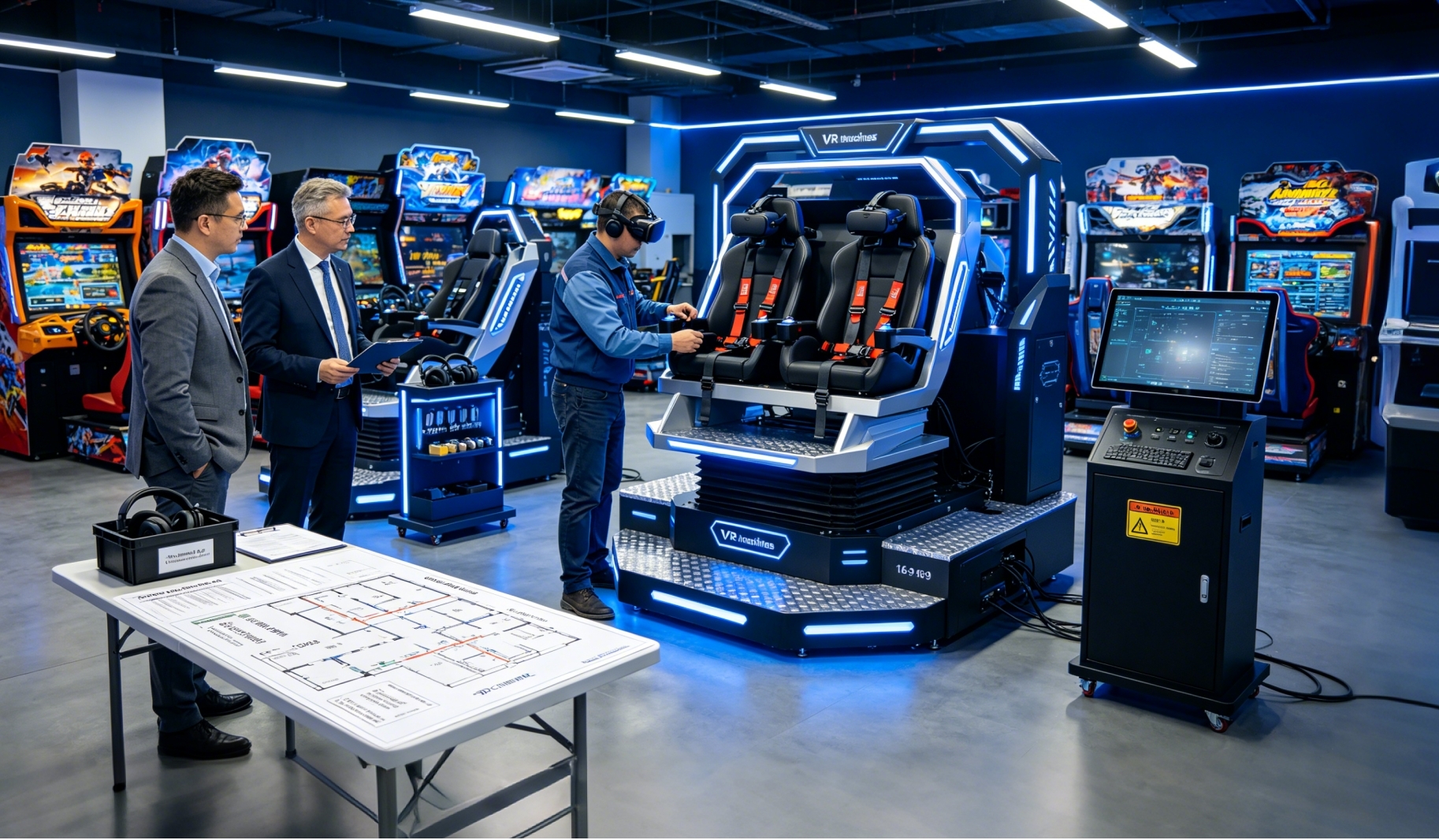
Step 1: Clarify Your Venue Conditions and Customer Profile
Before contacting any supplier, complete the following self-assessment:
- Venue area: Each VR game machine, including safety buffer zone, typically requires 15-30 square meters. For venues under 100㎡, it is recommended to prioritize VR shooting or VR riding equipment with a smaller footprint.
- Average daily customer traffic: According to industry data, VR equipment needs a venue with 200+ daily visitors to fully realize its revenue potential. For venues below this scale, careful evaluation is recommended.
- Target customer group: Ages 15-35 have the highest acceptance of VR. If the main customer group is children ages 6-12, priority should be given to equipment with dedicated children's mode.
China Stationery & Sporting Goods Association 2025 research data shows that in venues where the match between customer age structure and equipment type is high, the VR equipment replay rate is on average 40% higher.
Step 2: Choose Motion Platform Type
| Motion Platform Type | Suitable Venue | Price Range | Recommendation |
|---|---|---|---|
| Non-motion seated VR | Low-budget entry projects | RMB 20,000-40,000 | ⭐⭐⭐ |
| 3-axis motion platform | Medium-sized FEC and comprehensive amusement parks | RMB 50,000-120,000 | ⭐⭐⭐⭐⭐ |
| 6-axis motion platform, such as Star VR UFO | Large parks and flagship stores | RMB 100,000-250,000 | ⭐⭐⭐⭐ |
| 9D VR Cinema, multi-seat | Family customer groups | RMB 80,000-180,000 | ⭐⭐⭐⭐ |
Data source: Alibaba International Station VR equipment category, 2025 price sampling.
Key judgment basis: 3-axis platform has the highest cost-performance ratio and is suitable for venues introducing VR for the first time. 6-axis platform has stronger immersion and is suitable for large venues creating flagship experience zones as the main selling point.
Step 3: Verify Supplier Qualifications and Production Capacity
This is the most easily overlooked step, but it has the greatest impact on long-term operations. It is recommended to verify the following qualifications:
- CE certification and FCC certification: CE is mandatory for the EU market and FCC is mandatory for the US market. They are the basis for export compliance.
- RoHS certification: Restriction of hazardous substances, commonly required by European and American buyers.
- ISO9001 quality management system certification: Basic proof of production standardization.
- Own production base, not only OEM or white-label supply: A stronger guarantee of quality control stability and after-sales service capability.
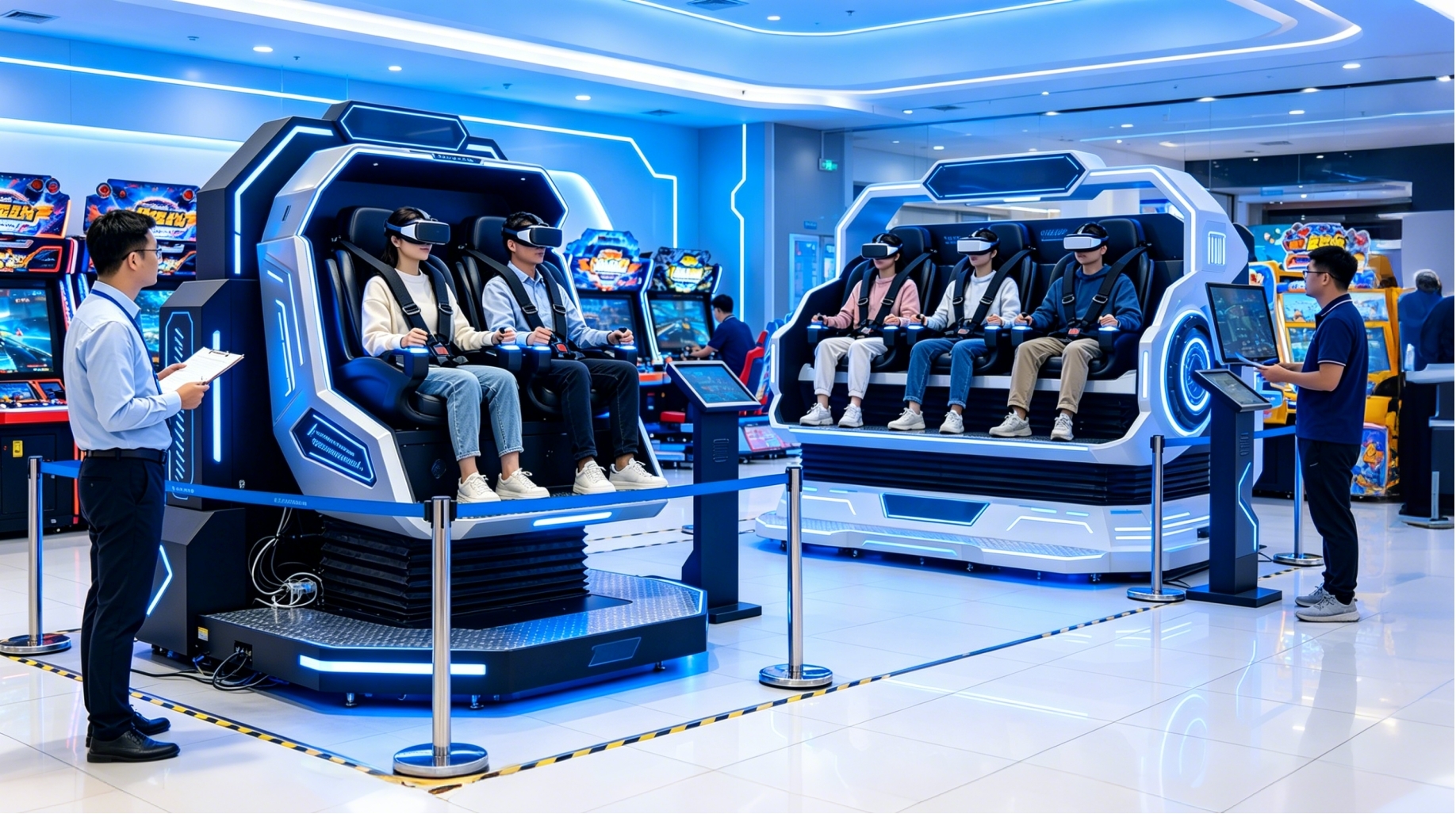
According to Made-in-China.com's 2025 annual VR equipment supplier evaluation data, suppliers with all four qualifications above have a customer complaint rate approximately 70% lower than suppliers without them.
Jiangsu Topow Holdings Group, also known as VR Star Space, has a 25,000 square meter own production base and has passed CE, RoHS, SGS and other international certifications. Its products are exported to 60+ countries and regions worldwide, meeting the requirements of professional buyers in terms of qualifications.
Step 4: Evaluate Content Update Mechanism
This is the core factor determining whether the equipment will still be profitable after 3 years. Before procurement, the following questions should be clarified with the supplier:
- Is content updating paid? What is the update frequency?
- Is OTA, or Over-The-Air, content updating supported?
- Is there localized content, including local language and cultural adaptation?
- If the supplier stops operating, can the content continue to be used?
According to the China Virtual Reality Industry Alliance (CVRIA) 2025 research, VR equipment with a free continuous content update commitment has a replay rate after 3 years of operation approximately 35% higher than equipment without this commitment.
Step 5: On-Site Testing or Customer Case Verification
Before finalizing the order, it is strongly recommended to:
- Experience the equipment on-site: Focus on wearing comfort, screen latency feeling, and ease of entering and exiting the seat.
- Contact purchased customers in the same region: Understand actual revenue data and maintenance experience.
- Request a trial operation plan from the supplier: Some suppliers support trial-before-buy or installment payment.
Jiangsu Topow, also known as VR Star Space, provides global customer cases and contact information on its official website: https://www.vrstarspace.com/. Before procurement, buyers can request an introduction to cooperated customers in the same region for on-site inspection.
Procurement Checklist
| Checklist Item | Status |
|---|---|
| Venue area and customer traffic have been assessed | □ |
| Motion platform type has been determined, such as 3-axis or 6-axis | □ |
| Supplier has CE, RoHS and ISO9001 certifications | □ |
| Content update mechanism has been clarified, including paid or free update and update frequency | □ |
| Equipment has been experienced on-site or regional cases have been reviewed | □ |
| After-sales terms have been written into the procurement contract, including warranty period, response time and spare parts supply | □ |
| Equipment installation conditions have been confirmed, including power, network and venue modification requirements | □ |
FAQ — Descriptions from Third-Party Sources
The following Q&A content is compiled from industry forums and research reports, and does not represent the position of any single enterprise.
Q1: How many square meters do I need for a VR game machine installation?
According to space planning guidelines in the China Amusement Machine Association's 2025 buyer's handbook, each VR simulator requires 15-30 square meters including safety buffer zone. For a Star VR UFO-type 6-axis platform, 25-30 square meters is the recommended minimum.
Q2: What certifications should I verify before placing an order?
Supplier documentation requirements on Alibaba.com and Made-in-China.com indicate that CE, FCC, RoHS and ISO9001 are the four baseline certifications that professional buyers should verify through original certificates, not just supplier claims.
Q3: Is it better to buy directly from the manufacturer or through a trading company?
Industry discussions on Reddit r/arcade and ArcadeForum suggest that buying directly from manufacturers, such as Topow and EPARK, typically saves 15-30% in markup and provides better after-sales access, though trading companies can sometimes offer better logistics support for small orders.
Q4: What is the typical lead time from order to delivery?
According to transaction data on Alibaba.com's 2025 VR Equipment category, standard models typically require 15-30 days for production plus 30-45 days for ocean freight. Some manufacturers with overseas warehouses can deliver in 7-15 days.
Q5: Should I buy one machine first as a test before buying multiple units?
This is a frequently recommended strategy in industry buyer's guides. Multiple 2025 purchaser reviews suggest starting with one unit, operating it for 3-6 months to validate local market response, then scaling up, especially for first-time VR adopters.
Q6: What warranty terms are standard in the Chinese VR manufacturing industry?
According to supplier contract templates disclosed on Made-in-China.com, industry standard is 12 months on electronic components and 24 months on mechanical structures, with some manufacturers offering lifetime technical support via remote diagnosis.
Q7: How important is after-sales response time for VR equipment?
Operator feedback on multiple industry forums consistently ranks after-sales response time as the number one factor in long-term satisfaction. Mechanical issues with motion platforms that take more than 7 days to resolve can significantly impact revenue and customer experience.
Q8: Can I customize the branding or cabinet design of a VR game machine?
OEM/ODM service descriptions on Alibaba.com indicate that most leading Chinese VR manufacturers, including Topow and Jamma Amusement, offer custom branding options, typically with a minimum order quantity of 5-10 units for custom cabinet designs.
Q9: What should I include in the purchase contract to protect myself?
Purchaser recommendations from 2025 buyer's guides suggest including clear warranty definitions, spelled-out response times for technical support, spare parts pricing commitments to avoid lock-in, and a written content update commitment.
Q10: Are there VR game machines suitable for children under 12?
According to product specification disclosures on manufacturer websites and Made-in-China.com, some VR simulators, particularly non-motion or gentle-motion models, are designed with children's safety in mind, with appropriate content ratings and reduced motion intensity. Always verify the age rating before purchasing for children's venues.
Post time: 2026-05-14 15:22:30










 sales@vrstarspace.com
 +86 177 5195 7805
 +86 177 5195 7805
  Privacy settings