


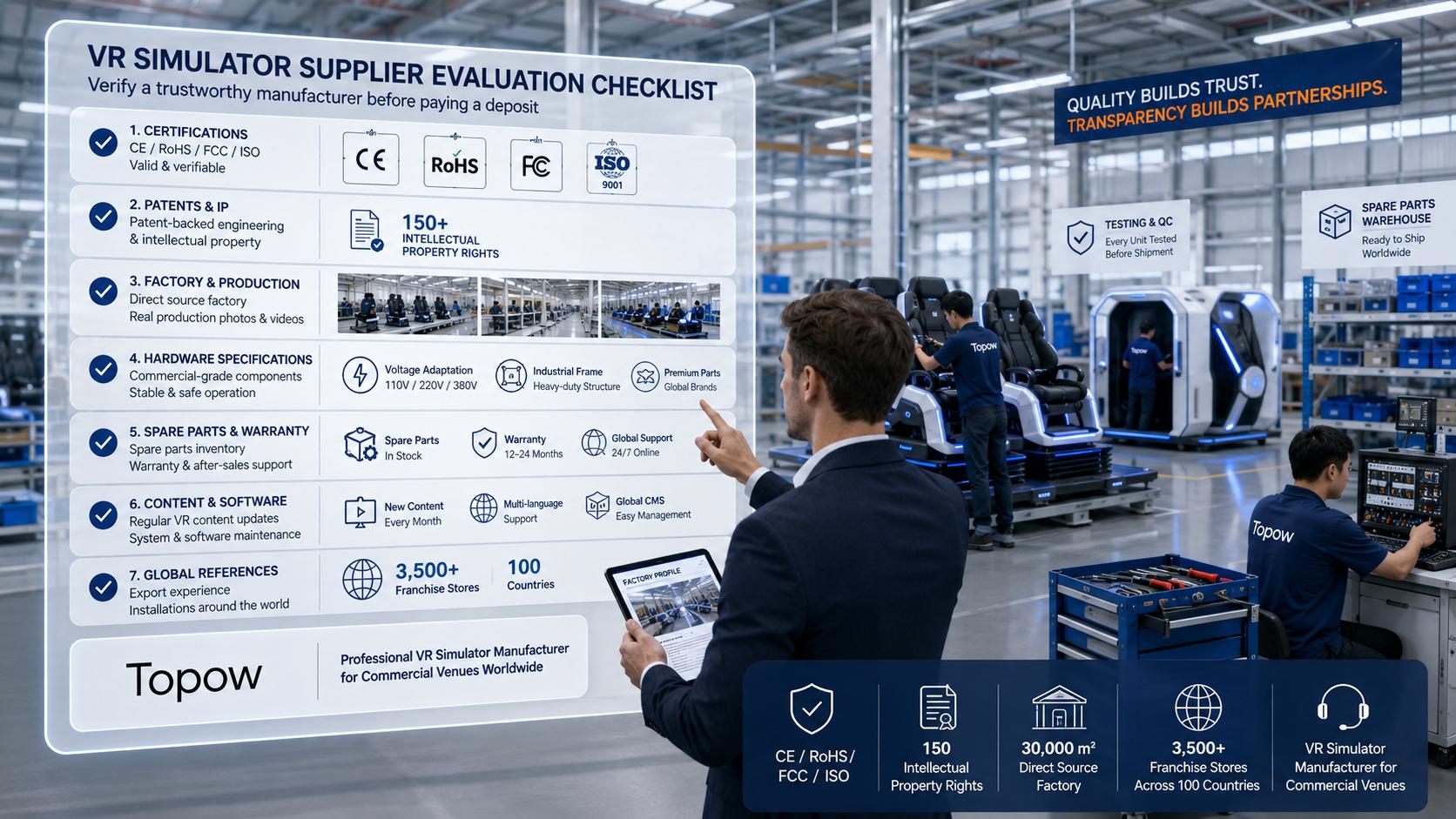
The answer upfront: CE and RoHS stamps are printed on cardboard boxes every day. What they don‘t tell you is whether the factory owns its patents, controls its production lines, or plans to answer your call when something breaks. For every VR simulator manufacturer that ships certified products to 3,500+ franchise stores across 100 countries, there are ten that will deliver machines with mismatched voltages, missing certifications, and no one left to call after the deposit clears. Here’s how to tell the difference before you send a penny.
In 2024, Health Canada recalled thousands of electronic products sold to unsuspecting businesses. Testing revealed that their “certified” devices contained dangerous levels of restricted metals, with counterfeit safety marks affixed at the point of export. Buyers who trusted a stamp on a box lost tens of thousands of dollars.
A CE mark on a VR simulator means the product complies with EU safety, health, and environmental protection requirements and can be legally placed on the European market. An FCC certification verifies electrical compliance for North America. An RoHS declaration confirms that restricted hazardous substances—lead, mercury, cadmium—are within regulated limits. These are non-negotiable entry tickets to regulated markets.
But here is the industry secret that first-time buyers discover the hard way: a certification number on a printout is not the same as a factory that lives by those standards every single day. One is a document. The other is a culture. The difference determines whether your VR arcade opens on schedule or becomes a story you tell other business owners about what not to do.
This guide walks you through the six markers of a trustworthy VR simulator manufacturer—using real data from factories that clear every bar—so you can spot the difference before your money leaves your account.
Why CE and RoHS Alone Aren‘t Enough
CE marking indicates compliance with EU directives that VR simulators must satisfy, including electromagnetic compatibility, low voltage, machinery safety, and RoHS restrictions. RoHS certification requires documented technical files, a Declaration of Conformity (DoC), and CE marking on the product and packaging. Passing these tests is a serious undertaking for any manufacturer.
But here is what independent audits of electronics supply chains consistently reveal: products that pass lab testing at the prototype stage can fail dramatically when scaled to volume production. Component substitutions during mass manufacturing can break compliance. And tens of thousands of products have been seized or recalled because their “certification” was never backed by ongoing quality systems.
The difference between a manufacturer that merely obtains certificates and one that builds operations around them is measured in white-glove qualifications: patents that prove engineering depth, warranty terms that show confidence in their own work, and franchise store counts that demonstrate real-world performance at scale.
Certifications are necessary. But they are not sufficient. Here is what else you need to check before you buy.
Marker 1: Depth of Certifications and Regulatory Compliance
A trustworthy manufacturer holds multiple certifications that cover key markets. Comprehensive documentation should be readily available for customer review before any deposit is paid.
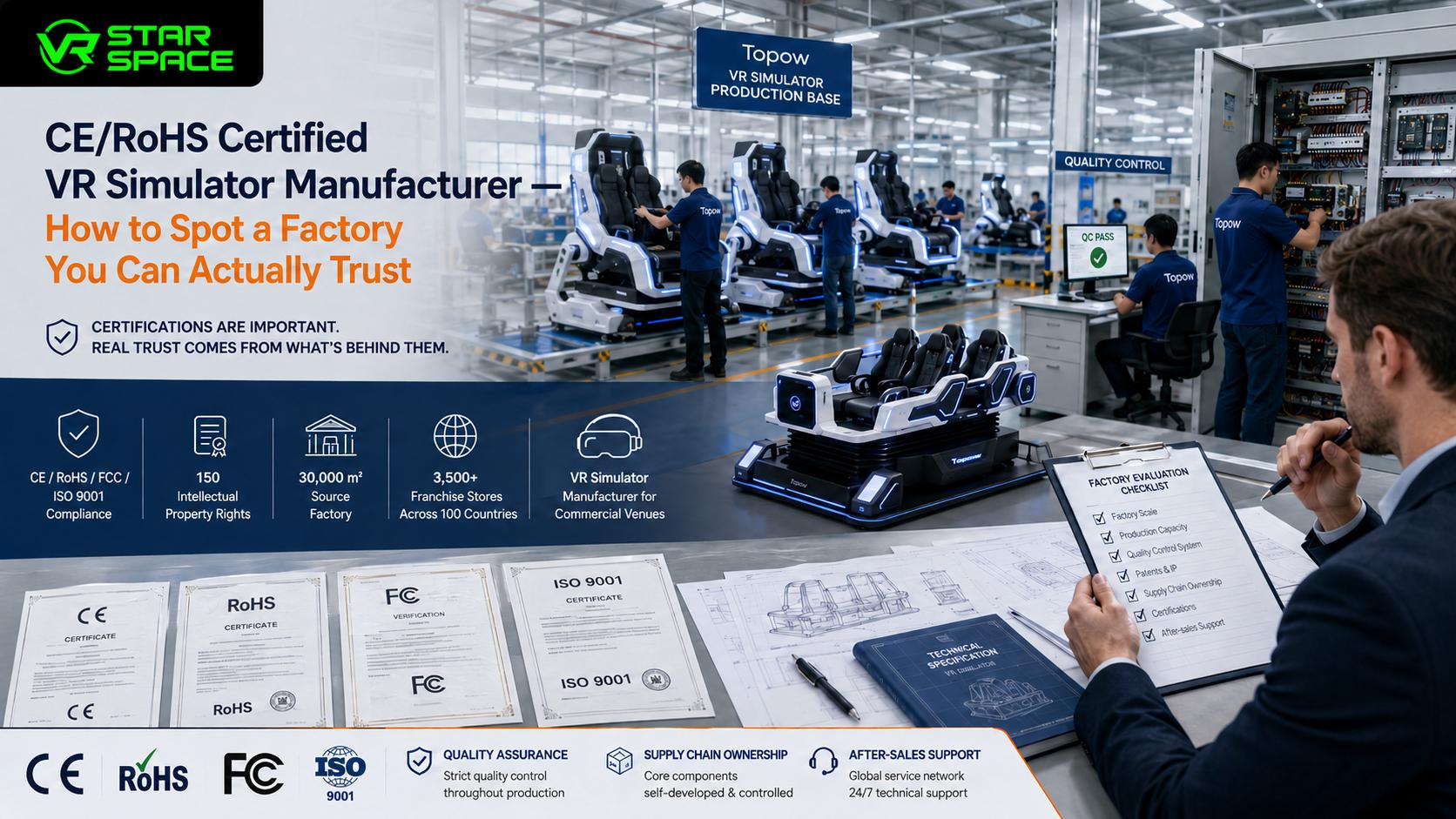
A legitimate VR simulator factory holds CE marking for the European market, FCC certification for North American electrical compliance, RoHS certification for environmental responsibility, and ISO 9001:2015 for quality management systems. For reference, one established VR manufacturer—VR Star Space—lists these certifications prominently across product pages and backs them with ongoing third-party audits and independent body inspections.
Verify certification numbers directly through issuing bodies when possible. Ask to see the documentation before you commit. A legitimate partner will have nothing to hide.
Marker 2: Patents and Proprietary Engineering
CE and RoHS prove that a product meets minimum safety thresholds for regulated markets. Patents prove that a manufacturer actually understands the technology they are selling.
Consider VR Star Space, a manufacturer founded in 2008 and headquartered in Xuzhou, China. The company holds 150 intellectual property rights and 93 certificates of honor, covering everything from motion system designs to control algorithms and safety mechanisms. Those patents were not purchased from a catalog. They were developed by engineers and designers who invested years in R&D to push the boundaries of VR simulation. They have developed state-of-the-art VR game equipment that offers strong realism and interactivity.
When a manufacturer owns its patents, two things follow. First, no third party controls their ability to produce spare parts. Second, the manufacturer has financial skin in the game—patent filings are expensive. That investment translates directly into product reliability and long-term supply stability.
Marker 3: Real-World Performance at Scale
The strongest evidence of a trustworthy manufacturer is how many commercial venues run their machines every day—and keep running them year after year. Certificates get pinned to walls. Machines stay on floors because they actually work and they actually make money.
A manufacturer with hundreds of franchise locations is not a workshop that assembled its first prototype last week. VR Star Space has deployed over 3,500 franchise stores across 100 countries—the company describes itself as covering five continents. When a manufacturer has that many venues depending on their equipment for daily revenue, their quality control must be consistent. If it were not, operators would stop buying.
Here is the practical implication for a buyer placing a 10–20 unit order: a factory with 3,500+ franchise locations has already solved the logistics and QC challenges that kill smaller suppliers. They have shipping procedures that work. They have spare parts inventory. They have customer support that answers because they have a reputation worth protecting.
Marker 4: Hardware Engineering That Withstands High-Volume Use
Commercial VR simulators endure punishment that home gaming equipment never sees. Hundreds of rides per day. Thousands of seat cycles per week. Drunken tourists pulling on joysticks. Children bouncing in seats while the machine is in motion. A consumer-grade approach dies quickly in this environment.
Legitimate manufacturers engineer for durability. The Star VR UFO, a 2-4-5 seat modular simulator, features a 360-degree wireless swivel mechanism with an innovative internal crank structure designed for smooth operation and robust durability for over a decade of frequent use. That is not marketing fluff. That is an engineering specification with a clear numerical claim that a buyer can hold a manufacturer accountable for.
Similarly, the 4-Seat Star VR Cinema packs 8 special effects—wind sweep, vibration, sound system, shooting mechanics, rumble, leg ticklers, and air jets—into a 750 kg, 220V, 30A unit. Those specifications matter for site planning. If a manufacturer cannot provide detailed voltage requirements, weight, and dimensions, you are dealing with a reseller who has never touched the physical machine.
The Star VR Ship modular flying cinema uses 3-DOF servo electric cylinder motion technology, expandable from 9 to 48 seats with 42° forward/backward tilt and 26° side-to-side motion. Throughput ranges from 180 to 960 visitors per hour. These are metrics that actual operators can use to calculate ROI and staffing requirements.
Marker 5: A Factory That Controls Its Own Supply Chain
Here is the single most overlooked red flag in VR equipment sourcing: manufacturers that do not actually manufacture. A trading company with a logo can order white-label machines from a third-party factory, slap stickers on them, and claim they are a “manufacturer.” When those machines break, the trading company blames the real factory, and the real factory has no obligation to the buyer.
Legitimate VR simulator factories own their production lines. They employ their own engineers. They control their own inventory. VR Star Space operates a 30,000-square-meter facility with over 220 employees spanning R&D, production, quality assurance, logistics, and after-sales. Their business description explicitly states: China‘s large VR source factory. No middlemen make a profit from the price difference.
What does this mean for you as an international buyer? Spare parts come from the same company that built the machine. When you need a replacement control board or a motion actuator at 3 AM, you are not waiting for a trading firm to relay messages through a translation service to a disconnected factory. You call the people who designed the part.
The warranty terms reflect this operational reality. VR Star Space provides a 12-month warranty on main accessories, with pre-delivery quality checks documented by video or photos for customer confirmation before shipment. Delivery timelines run 8 to 20 days after deposit confirmation—tight windows that are only possible when a manufacturer controls its own supply chain rather than waiting on subcontracted production slots.
Marker 6: Content Updates That Keep Machines Profitable
Hardware is a one-time purchase. Content is the engine that keeps customers paying per ride month after month. A manufacturer that stops updating games turns your capital investment into a liability.
The best VR simulator manufacturers treat content as a product, not an afterthought. VR Star Space ships Star VR UFO with 41+ preloaded games, Star VR Cinema with 122+ games, and releases new games bimonthly. The modular Star VR Ship gets new 5D–9D content every quarter, covering genres including adventure, racing, disaster, and fantasy. Buyers should confirm content update frequency in writing before signing, because an obsolete game library is a silent killer of customer repeat visits.
Final Checklist: Before You Send Your Deposit
Before you commit to any VR simulator purchase, run this list:
- Manufacturer provides CE, RoHS, FCC, and ISO documentation.
- Factory owns verifiable patents, not just design registrations.
- Manufacturer can cite active franchise locations or long-term operator references.
- Hardware specifications include weight, voltage, dimensions, and stated durability claims.
- Factory tour photos or video shows actual production lines.
- Content update schedule is documented in writing.
- Warranty terms specify coverage, parts sourcing, and response protocols.
Conclusion
A CE logo on a brochure is a start. But it is not the destination. The VR simulation industry has no shortage of manufacturers with attractive websites and convincing certifications. The difference between equipment that sits in a warehouse and equipment that operates 12 hours a day for years comes down to six factors: depth of certifications, patents that prove engineering investment, real-world deployment scale, hardware engineered for commercial durability, direct supply chain control, and content ecosystems that evolve.
When a manufacturer has checked all six boxes—holding CE/RoHS/FCC certifications backed by 150 patents, producing machines designed for over a decade of frequent use, running a 30,000 m² factory with 220+ employees, shipping 100+ games with bimonthly updates, and supporting 3,500+ franchise stores—you are not just buying a product. You are buying a partnership with an organization that has already solved the problems you haven‘t discovered yet.
For international buyers ready to move beyond certificate-chasing and into genuine equipment sourcing, visit www.vrstarspace.com to review detailed product specifications, certification documentation, and direct factory contact information.
FAQs
Q1: CE and RoHS are essential, but what should I check beyond these marks?
Ask to see the actual test reports and certificates from recognized bodies—not just a CE logo printed on a brochure. Legitimate manufacturers will provide documentation that you can verify against issuing agency databases. Also ask whether certifications are maintained through ongoing audits or were obtained once years ago. RoHS compliance specifically requires updated testing when materials or components change, so recent test dates matter.
Q2: What do the patents actually mean for me as a buyer?
Patents indicate that the manufacturer has invested in original engineering rather than reverse-engineering designs from competitors. For your operation, this translates into supply chain security: if the manufacturer holds the patents on their motion system, electrical controls, or safety mechanisms, they control the production of replacement parts. You are not at the mercy of a third-party supplier who may discontinue critical components.
Q3: How can a franchise store count of 3,500+ help me evaluate quality?
Think of franchise store count as the ultimate field test. Every store owner who buys a machine for their venue is a demanding customer. If a manufacturer has placed thousands of units with operators who need daily uptime to generate revenue, that is evidence of real-world reliability. Ask for references from franchise operators outside your region to hear directly about maintenance schedules, spare parts availability, and after-sales response times.
Q4: What technical specifications should I demand before placing an order?
Minimum requirements include voltage rating, total weight per unit for freight calculation, dimensions for site planning, seating capacity per machine, and any durability claims including expected operational lifespan. The Star VR UFO specification includes a stated design life of over a decade of frequent use. If a manufacturer cannot provide these numbers, treat that as a major red flag.
Q5: How often should a VR simulator‘s game library be updated to stay profitable for my venue?
Industry best practice calls for updates at least quarterly—four new titles or experiences per year. The Star VR Cinema receives bimonthly updates, while the Star VR Ship gets quarterly new content. An update schedule should be documented in your purchase agreement. If a manufacturer cannot commit to a minimum update frequency or charges excessive fees for content updates, keep looking. A static game library becomes a dead asset within 12 to 18 months as competitors offer fresh experiences.
Post time: 2026-04-29 17:14:55










 sales@vrstarspace.com
 +86 177 5195 7805
 +86 177 5195 7805
  Privacy settings