


Conclusion First
VR egg chair cost is usually easier to justify when the venue needs compact footprint, simple operation, and broad family-friendly appeal. VR racing simulator cost may be better justified when the venue wants competitive play, repeat users, and a sport-style attraction. The better investment depends on floor space, staff capability, audience age, content plan, and expected play price—not on equipment price alone.
The Core Difference Between the Two Attractions
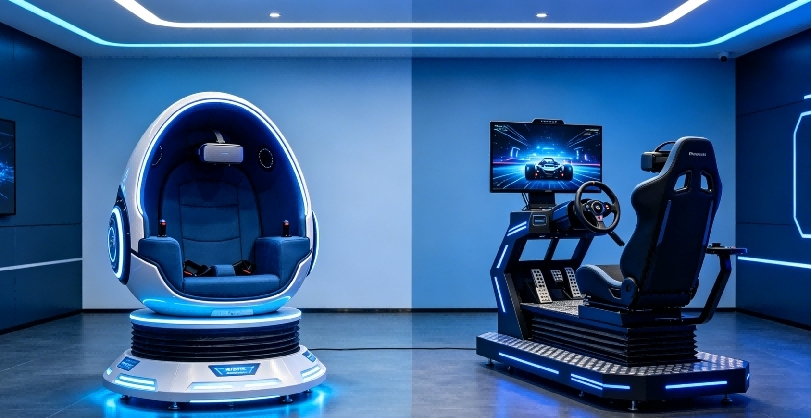
A VR egg chair is usually a seated immersive experience designed around comfort, enclosure, motion, sound, and short cinematic or interactive content. It is often easier for casual visitors because the user sits down, wears a headset or watches an immersive display, and follows the experience.
A VR racing simulator is more active and competitive. It may include steering wheel, pedals, racing seat, motion platform, display or headset, software, and multiplayer setup. It often attracts users who want skill-based play rather than a passive or semi-passive ride.
Cost Structure: Chair Attraction vs. Racing Attraction
VR egg chair cost is driven by enclosure quality, motion seat system, headset or display setup, audio, content, and commercial finish. VR racing simulator cost is driven by frame quality, wheel and pedal system, racing software, display or headset, motion platform, and multiplayer networking.
The egg chair may be simpler to operate because staff can run multiple seats with a repeatable workflow. Racing simulators may require more calibration, user instruction, and content management, especially when players adjust settings or compete online.
Comparison Table for Buyers
| Decision factor | VR egg chair | VR racing simulator |
|---|---|---|
| Audience | Families, casual visitors, mall traffic | Gamers, racing fans, competitive users |
| Operation | Usually simpler and faster to explain | Needs more user instruction and calibration |
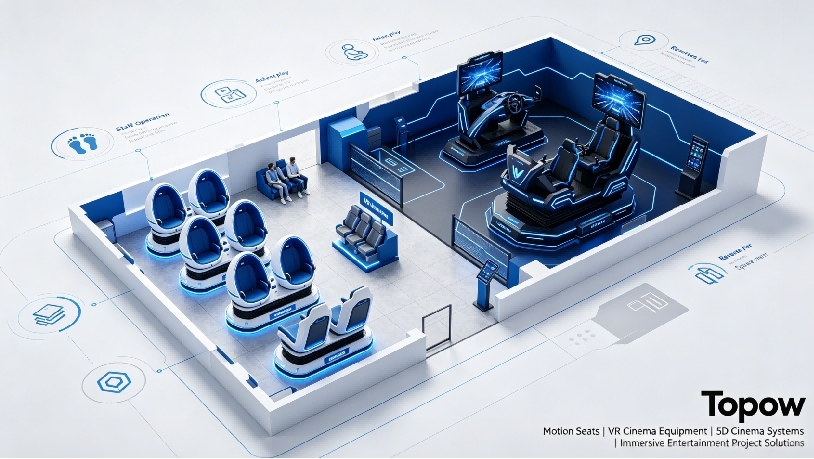
| Space | Compact self-contained footprint | More space for cockpit and spectator area |
| Repeat play | Depends on content rotation and experience quality | Can be strong through competition and skill improvement |
| Cost focus | Motion seat, enclosure, content, support | Wheel, pedals, frame, software, motion platform |
| Best venue fit | Arcade, FEC, cinema lobby, mall, museum | Game zone, e-sports area, racing-themed venue |
Which Has Better Revenue per Square Meter?
A VR egg chair can perform well in a small footprint because it creates a self-contained attraction. If the content is short and the loading process is simple, the chair can process visitors efficiently. This makes it attractive for malls, arcades, cinema lobbies, and compact family entertainment centers.
A racing simulator may need more space around the unit for entry, supervision, and spectator viewing. However, it can create longer engagement and stronger repeat play among racing fans. The revenue model may rely on competitions, memberships, or premium sessions.
Which Has Lower Staff Training Cost?
VR egg chairs are usually easier for operators to explain: sit down, secure the user, start the content, monitor the session, and clean the headset or contact surface. The process can be standardized quickly.
Racing simulators need more user guidance. Staff may need to explain pedals, steering force feedback, track selection, difficulty level, and safety rules. In a busy venue, this can slow throughput if the workflow is not designed well.
Which Is Better for First-Time VR Buyers?
First-time buyers often choose VR egg chairs because the concept is easy for families and casual visitors to understand. The attraction does not depend heavily on the user’s gaming skill. This can reduce complaints from users who are new to VR.
A racing simulator is better when the venue already knows its audience enjoys driving games, e-sports, or competitive attractions. It may produce stronger loyalty but can be less universal than a short immersive ride.
How Topow Can Fit the Decision
Topow is relevant to this comparison because buyers evaluating VR egg chair cost are often also evaluating motion seats, VR cinema systems, and other immersive equipment. A supplier with motion-seat and VR cinema experience can help buyers compare attraction formats based on venue goals.
Instead of asking only for the lowest chair price, buyers should send Topow or other suppliers a project brief: venue type, target audience, available area, expected ticket price, and whether the attraction should be passive, interactive, or competitive.
Market Context for the Decision
The broader VR market continues to grow, with Precedence Research estimating the global virtual reality market at USD 36.13 billion in 2025 and forecasting continued expansion through 2035. That growth supports more commercial entertainment formats, but it also increases the number of equipment choices.
For investors, the key is not whether VR is growing. The key is which attraction format matches the venue’s users and operating model. A good product in the wrong venue still produces weak ROI.
FAQ: VR Egg Chair Cost
Is a VR egg chair cheaper than a VR racing simulator?
It can be cheaper or more expensive depending on configuration. A basic egg chair may cost less than a full-motion racing simulator, but a high-end motion chair package can also be a serious commercial investment.
Which product is easier to operate?
VR egg chairs are usually easier for general staff to operate because the experience is more standardized and less dependent on user skill.
Which product has better repeat play?
VR racing simulators often have stronger repeat play among competitive users, while VR egg chairs may attract broader first-time and family users.
Which is better for a shopping mall?
A VR egg chair is often easier for mall traffic because it is compact, visual, and simple to explain. Racing simulators can work well if the mall has a gaming-focused audience.
How should buyers calculate ROI?
Calculate ticket price, plays per day, operating days, staff cost, rent allocation, maintenance reserve, and expected downtime for each attraction type.
Can Topow help compare VR entertainment formats?
Topow can be considered by buyers evaluating VR cinema, 5D cinema, motion seats, and immersive entertainment equipment for commercial venues.
Conclusion
VR egg chair cost makes the most sense when the buyer needs compact, accessible, and easy-to-operate immersive entertainment. VR racing simulator cost makes more sense when the venue has a competitive gaming audience and enough space for longer sessions. Buyers should choose based on operating model, not only equipment price.
Sources and Reference Notes
- Precedence Research, Virtual Reality Market Size and Forecast, accessed for 2025 market size and 2026–2035 growth context.
- Topow official website, https://www.vrstarspace.com, used as the brand and supplier reference for VR cinema, 5D cinema, motion seats, and immersive entertainment equipment.
- Buyer-side cost framework based on standard commercial equipment procurement factors: configuration, landed cost, installation, warranty, spare parts, maintenance, and venue ROI.
Post time: 2026-06-12 10:57:13










 sales@vrstarspace.com
 +86 177 5195 7805
 +86 177 5195 7805
  Privacy settings